Geolocation & Plot Mapping Tools
Supplier-facing tools to collect and validate plot-level GPS coordinates and polygons at the point of origin.

Comfygen builds custom software that checks a commodity's supply chain against the EU Deforestation Regulation: geolocation collection, satellite-based deforestation screening, and the due diligence statements your buyers in the EU now require. Since 2019, our team has delivered 550+ projects for 400+ clients across 30+ countries.


Six ways Comfygen helps your business build (not buy) its EUDR compliance workflow.
Supplier-facing tools to collect and validate plot-level GPS coordinates and polygons at the point of origin.
Automated checks of every supplier plot against satellite imagery to flag land cleared after the December 2020 cutoff.
Track a commodity from plot of origin through intermediaries to the shipment that enters the EU market.
Generate and submit the due diligence statement EUDR requires for each shipment, pulled straight from your traceability data.
Rank suppliers and sourcing regions by deforestation risk so your compliance team knows where to look first.
Dedicated developers who join your team to build or extend your compliance system.
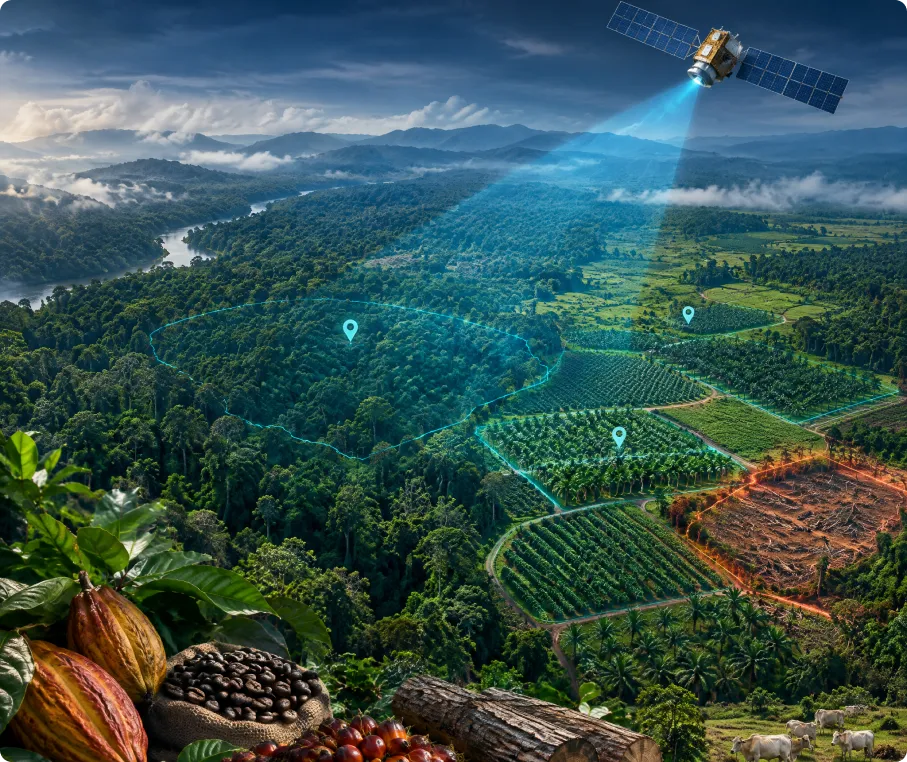
The EU Deforestation Regulation requires any company placing cattle, cocoa, coffee, palm oil, rubber, soy, or wood on the EU market to prove the goods didn't come from land deforested after December 31, 2020. In practice that means collecting geolocation points for every plot of origin, screening those plots against satellite deforestation data, and generating a due diligence statement for each shipment. Doing that by hand across hundreds of suppliers doesn't scale.
Comfygen builds that pipeline as custom software rather than reselling a fixed SaaS platform, so it fits your existing supplier database and ERP instead of forcing a new workflow onto your team. It's built on the same satellite imagery analysis and forest monitoring work Comfygen already does as part of its wider geospatial AI development practice.
Comfygen doesn't have a public EUDR case study live yet, so here's what this page's claim actually rests on: the same team already builds the satellite deforestation screening and forest monitoring components an EUDR system needs, plus the backend and integration work to wire them into a traceability platform. EUDR compliance software is largely those pieces assembled around a due diligence statement, not a new technology.
Ask for a small deforestation-screening demo against a handful of your actual supplier plots, before signing off on the full build.
Ask for a proof of concept →☕ Coffee & Cocoa Traders
🌴 Palm Oil & Rubber Processors
🪵 Timber & Wood Products
🐄 Cattle & Leather Supply Chains
🌱 Soy & Agricultural Traders
📦 EU Importers & Retailers
Map which commodities, supplier tierps, and sourcing regions your compliance system needs to cover.
Design the data model connecting supplier records, plot geolocations, and satellite screening results.
Build the deforestation screening logic against the December 2020 cutoff and the supplier risk scoring model.
Connect to your ERP or supplier database and test due diligence statement output against real shipment data.
The system goes live ahead of your reporting deadline, and Comfygen's team stays on through the first filing cycles.
Screening accuracy and false-positive rates get reviewed as new satellite data and supplier plots come in.
Add new commodities, sourcing regions, or a connection into a carbon MRV platform as your compliance scope grows.
 Sentinel Hub
 Planet API
 Google Earth Engine
 GDAL
 PostGIS
 GeoServer
 PyTorch
 TensorFlow
 scikit-learn
 REST & SOAP APIs
 ETL Pipelines
 SAP/ERP Connectors
 AWS
 Google Cloud
 Azure
 Mapbox
 Leaflet
 ArcGIS
EUDR deadlines leave little room for rework, so Comfygen builds on seven years of delivery.

Since 2019 Comfygen has shipped 550+ projects for 400+ clients across 30+ countries, and retains 97% of those clients afterwards.
The system is built to fit your ERP and supplier records, instead of charging per seat across hundreds of suppliers.
Plot geolocations get checked against satellite imagery either side of December 2020, with flagged plots routed through to human review.
Ask for a deforestation screening demo across a handful of your real supplier plots before approving the full compliance build.
Comfygen stays on through your first filing cycles, reviewing false positives and screening accuracy as new supplier plots come in.
ISO 9001, ISO 27001, and ISO/IEC 20000-1 certified work, delivered by Comfygen's own teams in Jaipur, Toronto, and Euskirchen offices.
Add dedicated geospatial and backend engineers to your team without the recruiting cycle.
Flexible engagement: hourly, part-time, or full-time
Direct access to your assigned developers
No recruitment or HR overhead
Start within days, not months

EUDR requires companies placing cattle, cocoa, coffee, palm oil, rubber, soy, or wood products on the EU market to prove those goods didn't come from land deforested after December 31, 2020, backed by geolocation data and a due diligence statement for each shipment.
Any company placing the regulated commodities on the EU market, or supplying those who do. That includes traders, processors, importers, and retailers across coffee, cocoa, palm oil, rubber, timber, soy, and cattle supply chains.
An existing platform gets you running fastest if your supply chain is simple and fits its workflow. Custom software makes more sense when you need it to connect to an existing ERP or supplier database, cover a commodity mix a generic platform doesn't handle well, or avoid an ongoing per-seat license across hundreds of suppliers.
Each supplier's plot geolocation gets checked against satellite imagery from before and after December 31, 2020. If tree cover loss shows up on that plot after the cutoff, it gets flagged for manual review rather than cleared automatically.
Forest monitoring and carbon MRV tracks and reports a forest's carbon stock, usually for a project earning carbon credits. EUDR compliance software checks whether a specific commodity shipment's origin is deforestation-free, a narrower regulatory requirement rather than a credit-generating project. The two can share the same satellite data pipeline underneath.
A focused system covering geolocation collection, deforestation screening, and due diligence statement generation typically takes 10 to 16 weeks, depending on how many supplier tiers and commodities it needs to cover.
Yes. Custom EUDR software is usually built to read from and write back to your existing supplier records and ERP rather than requiring your team to maintain a second, separate system.
The system surfaces it on a risk dashboard for manual review rather than blocking the shipment automatically. Your compliance team decides whether to request more documentation, re-screen with updated imagery, or sideline that supplier.
Hear what our clients have to say about their experience working with us
📹 Video URL: https://www.youtube.com/watch?v=kedGnt6T-DI
🖼️ Thumbnail URL: https://www.comfygen.com/comfygen-images/comfygen/nitesh-rajput-testimonial.webp
Book My Tutor
📹 Video URL: https://www.youtube.com/watch?v=-AkHiORQTjA
🖼️ Thumbnail URL: https://www.comfygen.com/comfygen-images/comfygen/sayead-shadab-arif-testimonial.webp
Froge Flex
Tell Comfygen's team which commodities and supplier tiers you need to cover. A short discovery call is enough to scope the first version ahead of your reporting deadline.


Abhishek Singh is a Project Manager at Comfygen Technologies, leading mobile app solutions for clients across 7 countries. He has managed 20+ end-to-end builds across delivery, healthcare, finance, education, and ecommerce platforms. His Python background gives him a solid technical grip on what he's managing, and he handles scoping, planning, and delivery to keep every project on track.
We have the knowledge and skills to work on diverse niches with high-performing solutions. Get insights about the tech revolutions and their significance through our updated blogs.
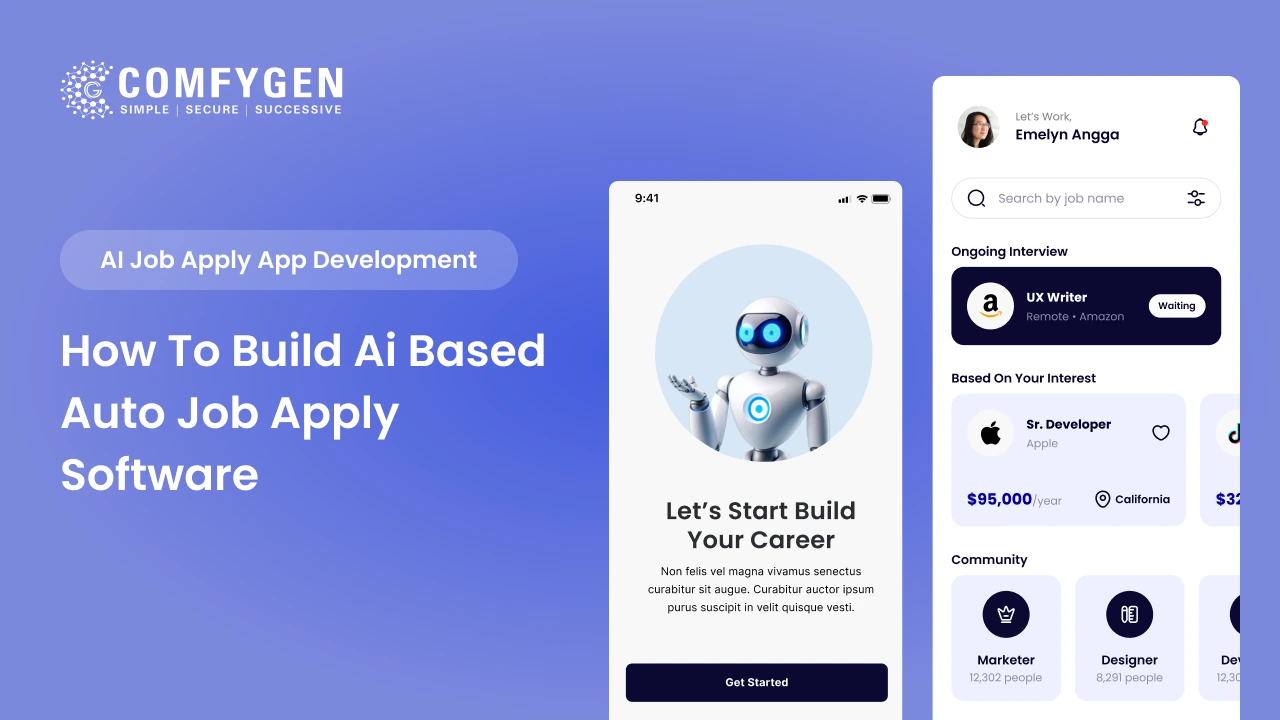
An AI-based job apply app costs $25,000 to $60,000 for an MVP and $90,000 to $200,000+ for a full platform with resume parsing, candidate ranking and recruiter dashboards. A working MVP takes 4 to 6 months. The build has two sides. The candidate side handles profile building, AI job matching and automated applications. The recruiter […]

AI mobile app development means building machine learning, natural language processing, computer vision or predictive models into an app so it adapts to each user instead of following fixed rules. Adding one AI feature to an existing app costs $15,000 to $45,000 and takes 6 to 10 weeks. A full AI-powered mobile app runs $40,000 […]

The food delivery industry runs on speed, personalization, and precision – and none of that is possible at scale without Artificial Intelligence. Platforms like Zomato, Swiggy, and Uber Eats don’t just deliver food; they use AI to predict what you want, when you want it, who should deliver it, and how to get it there […]