Custom GIS Application Development
Desktop and web GIS applications built around how your team actually works, not a generic off-the-shelf tool.
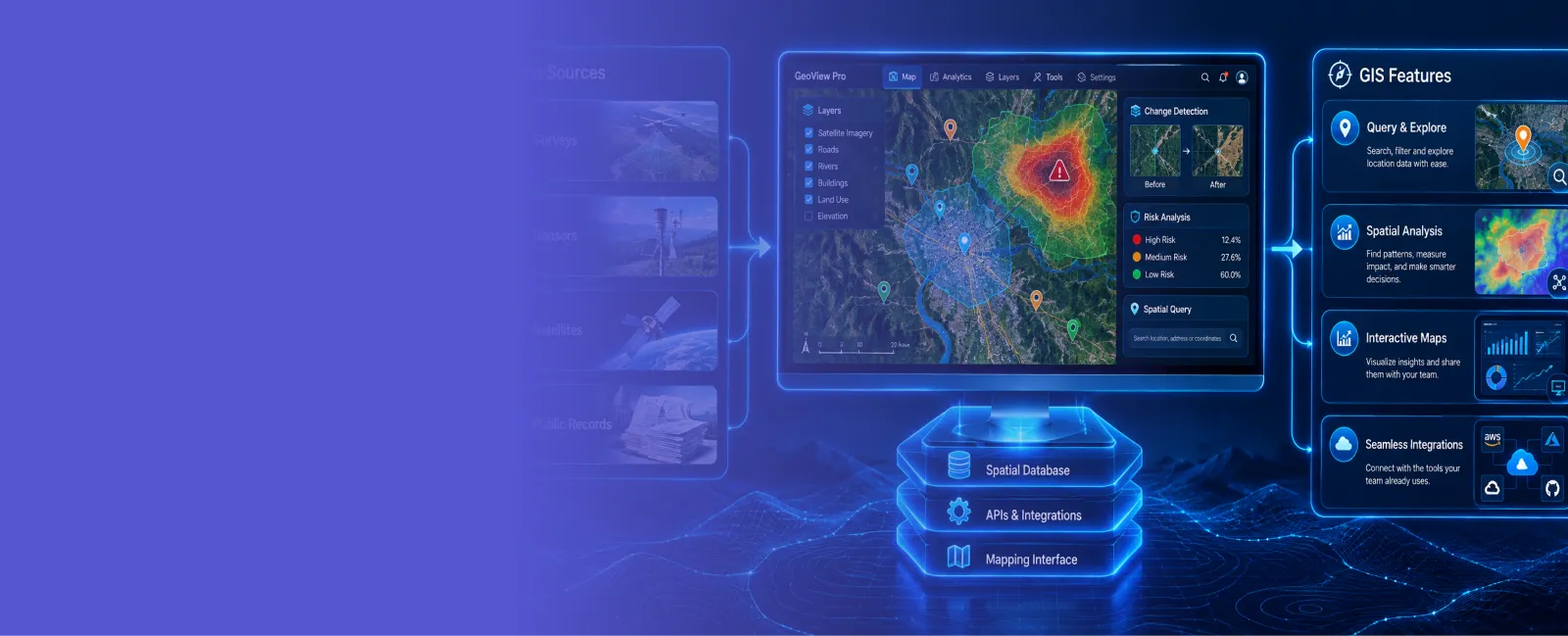
Comfygen builds custom GIS software, from WebGIS platforms to spatial databases, for companies that need to map, analyze, and act on location data. Since 2019, our team has delivered 550+ projects for 400+ clients across 30+ countries.


Six ways Comfygen helps a team put location data to work.
Desktop and web GIS applications built around how your team actually works, not a generic off-the-shelf tool.
Browser-based mapping platforms built on GeoServer and open mapping APIs, so a map opens for anyone with a link.
Spatial databases on PostGIS, Oracle Spatial, or SQL Server, built to hold millions of location records without slowing down.
Interactive 2D and 3D maps, dashboards, and geoprocessing tools that turn raw coordinates into a readable picture.
Moving legacy GIS data onto a modern stack, and connecting it to the business intelligence tools your team already runs.
Dedicated GIS developers and consultants who join your team for a single project or an ongoing build.
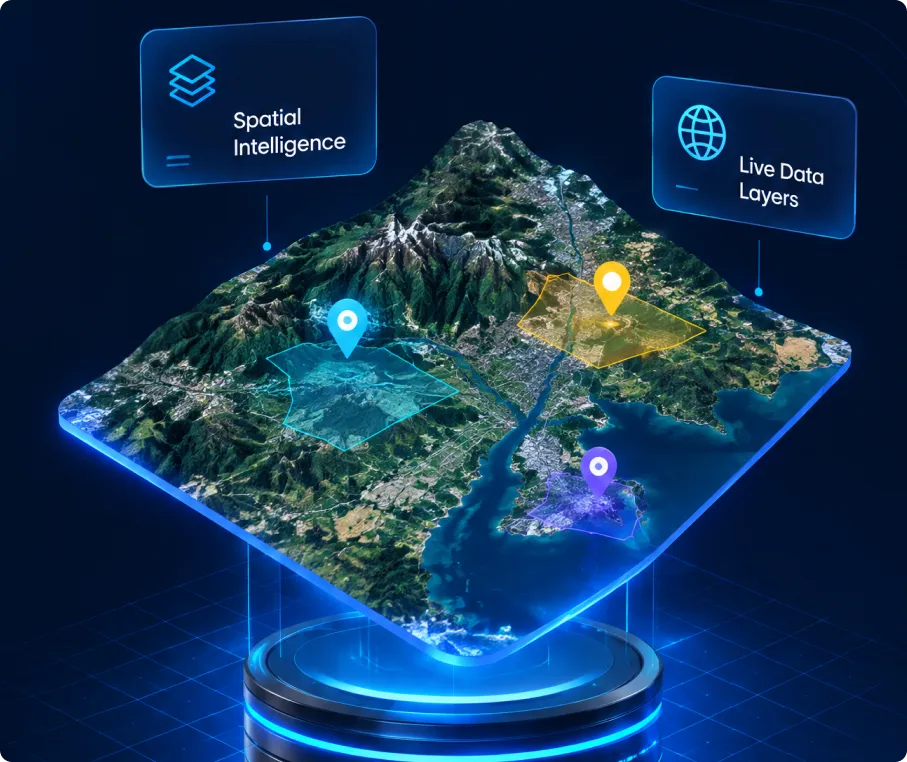
GIS software development builds the applications that capture, store, analyze, and display location data, so a team can see patterns on a map instead of buried in a spreadsheet. A custom GIS system pulls data from surveys, sensors, satellites, or public records into one place, then lets a team query it, run spatial analysis on it, and share it as an interactive map.
Comfygen builds these systems end to end: the spatial database underneath, the mapping interface on top, and the integrations that connect it to the tools a team already uses. The same team runs Comfygen's wider geospatial AI development work, so a GIS platform can plug straight into satellite imagery analysis or a wildfire risk tool later without a rebuild.
Comfygen does not have a public GIS case study live yet, so here is what this page's claim actually rests on: the same engineering team already delivers AI and machine learning development and IoT development for clients in 30+ countries. GIS work draws on that directly. A spatial database is still a database, a mapping interface is still a web and mobile interface, and a geoprocessing model reuses the same AI development practice the team already runs.
Ask for a small GIS proof of concept on your own data, scoped to a couple of weeks, before signing off on the full build.
Ask for a proof of concept →🌾 Agriculture
🏙️ Urban Planning
⚡ Utilities & Energy
🏛️ Government & Public Sector
🛡️ Insurance & Risk
🚚 Transportation & Logistics
Map your data sources, users, and the decisions the GIS platform needs to support.
Spatial database schema, map layers, and system architecture planned before a line of code gets written.
Core GIS application and spatial database get built in sprints, visible to you at each one.
Platform goes live on cloud or on-premise infrastructure, tested against your real data.
Bug fixes, security patches, and data updates after launch.
Query speed and map load times get tracked and tuned as data volume grows.
New layers, new data sources, or AI features added on as the platform grows, including a path into satellite imagery analysis or wildfire risk modeling.
 ArcGIS
 QGIS
 GeoServer
 MapServer
 PostGIS
 Oracle Spatial
 SQL Server
 Google Maps
 Mapbox
 Leaflet
 OpenLayers
 AWS Cloud
 Microsoft Azure
 Google Cloud
 Docker
Comfygen brings software delivery experience since 2019 into GIS projects, backed by dedicated geospatial engineers.

Since 2019, Comfygen's team has shipped 550+ projects for 400+ clients across 30+ countries, with a 97% client retention rate.
Your project gets engineers who work in PostGIS, GeoServer, and the Esri stack daily, not generalists learning spatial data midway.
Every GIS build starts from your own data and coordinate systems, so the platform fits existing workflows instead of replacing them.
Ask for a working proof of concept on your own data before approving the full build, so nothing rests on trust.
Comfygen's team stays on after go-live for fixes, new data sources, and changes as your mapping needs grow, not a handoff.
ISO 9001, ISO 27001, and ISO/IEC 20000-1 certified, with delivery teams working from Jaipur, Toronto, and Euskirchen across time zones.
Add dedicated GIS engineers to your team without the recruiting cycle.
Flexible engagement: hourly, part-time, or full-time
Direct access to your assigned developers
No recruitment or HR overhead
Start within days, not months

GIS software is a type of software designed to capture, store, analyze, manage, and present geospatial data. It gives a team a framework for organizing and querying spatial data to understand and solve real-world location problems. Examples of off-the-shelf GIS software include ArcGIS, QGIS, and MapInfo.
Off-the-shelf tools like ArcGIS or QGIS work well for general mapping but rarely fit a specific workflow without heavy configuration. Custom GIS software is built around your exact data sources, user roles, and the decisions your team actually makes, so there is nothing to work around.
A focused GIS application or WebGIS platform typically takes 8 to 16 weeks, depending on how many data sources it connects to and how much of the spatial database needs building from scratch.
Yes. AI can automatically flag errors and inconsistencies in GIS data, such as incorrect or missing attribute values, and suggest corrections based on patterns in the rest of the dataset. It can also fill gaps by predicting values from nearby known data points.
Yes. Field teams often work without reliable signal, so Comfygen builds offline-first mobile GIS apps that capture data locally and sync once a connection is back.
Yes. Comfygen moves legacy GIS data, shapefiles, geodatabases, or an old on-premise system, onto a modern spatial database and connects it to the business intelligence tools your team already uses.
Yes. GIS developers can join your team on an hourly, part-time, or full-time basis, working directly with your in-house team or as an extension of it.
Comfygen builds to ISO 9001:2015, ISO/IEC 20000-1:2018, and ISO 27001 standards, with role-based access control on sensitive map layers, so government and utility clients can set exactly who sees what.
Hear what our clients have to say about their experience working with us
📹 Video URL: https://www.youtube.com/watch?v=kedGnt6T-DI
🖼️ Thumbnail URL: https://www.comfygen.com/comfygen-images/comfygen/nitesh-rajput-testimonial.webp
Book My Tutor
📹 Video URL: https://www.youtube.com/watch?v=-AkHiORQTjA
🖼️ Thumbnail URL: https://www.comfygen.com/comfygen-images/comfygen/sayead-shadab-arif-testimonial.webp
Froge Flex
Tell Comfygen's team what data you have and what your users need to see on a map. A short discovery call is enough to scope the first version.


Abhishek Singh is a Project Manager at Comfygen Technologies, leading mobile app solutions for clients across 7 countries. He has managed 20+ end-to-end builds across delivery, healthcare, finance, education, and ecommerce platforms. His Python background gives him a solid technical grip on what he's managing, and he handles scoping, planning, and delivery to keep every project on track.
We have the knowledge and skills to work on diverse niches with high-performing solutions. Get insights about the tech revolutions and their significance through our updated blogs.
An AI-based job apply app costs $25,000 to $60,000 for an MVP and $90,000 to $200,000+ for a full platform with resume parsing, candidate ranking and recruiter dashboards. A working MVP takes 4 to 6 months. The build has two sides. The candidate side handles profile building, AI job matching and automated applications. The recruiter […]
AI mobile app development means building machine learning, natural language processing, computer vision or predictive models into an app so it adapts to each user instead of following fixed rules. Adding one AI feature to an existing app costs $15,000 to $45,000 and takes 6 to 10 weeks. A full AI-powered mobile app runs $40,000 […]
The food delivery industry runs on speed, personalization, and precision – and none of that is possible at scale without Artificial Intelligence. Platforms like Zomato, Swiggy, and Uber Eats don’t just deliver food; they use AI to predict what you want, when you want it, who should deliver it, and how to get it there […]