GIS Software Development
Custom GIS applications, WebGIS platforms, and spatial databases built on PostGIS, GeoServer, and the Esri and QGIS ecosystem.

Comfygen builds custom geospatial AI platforms: software that reads satellite imagery, GIS layers, and sensor data, then detects change and predicts risk on its own. Hire our developers to take a geospatial idea from data pipeline to production dashboard, backed by 7+ years of software delivery across 550+ projects.


Six services Comfygen's developers build for clients who need a geospatial AI platform without hiring and managing an in-house team.
Custom GIS applications, WebGIS platforms, and spatial databases built on PostGIS, GeoServer, and the Esri and QGIS ecosystem.
Platforms that ingest Sentinel, Landsat, and SAR data and turn it into land cover maps, change detection, and anomaly alerts.
Machine learning models trained on satellite and aerial imagery for object detection, classification, and monitoring at scale.
Fire risk scoring, spread prediction, and situational awareness tools built on NASA FIRMS data and live weather feeds.
Digital MRV platforms for forest carbon projects, biomass estimation, and deforestation alerts aligned with Verra and Gold Standard.
Due diligence platforms that trace a commodity to its exact plot and flag deforestation risk under the EU Deforestation Regulation.
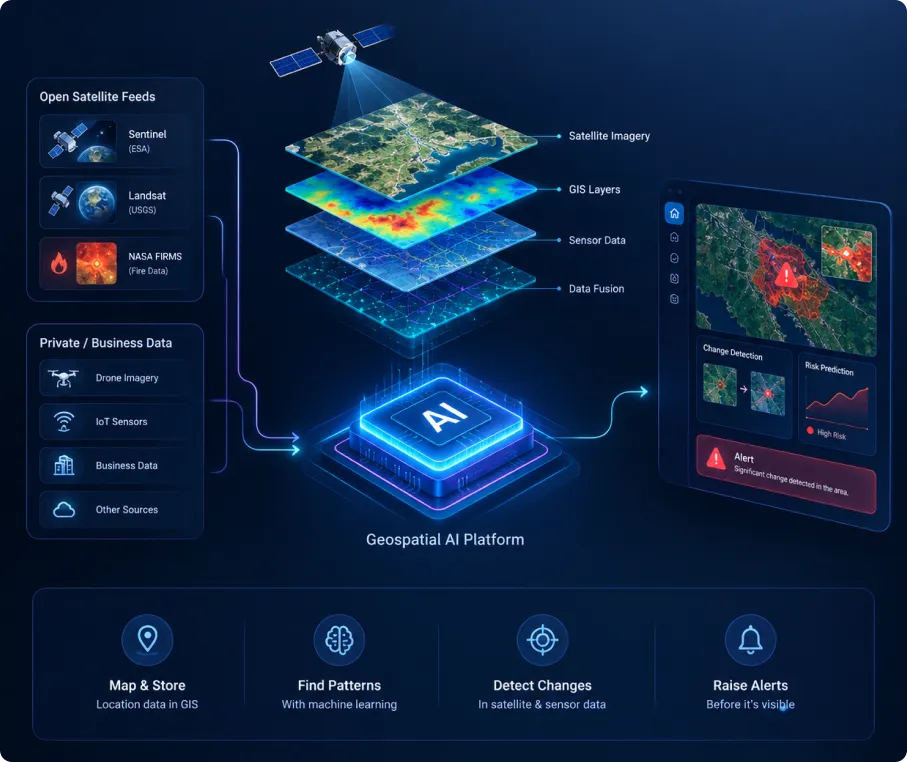
Geospatial AI combines two fields: Geographic Information Systems, which store and map location data, and machine learning, which finds patterns in it. Put together, a geospatial AI platform can read satellite images, flag changes on the ground, and raise an alert before a person would ever spot it by eye.
Comfygen's developers build this kind of system for clients who don't have a geospatial team in-house yet, starting from open satellite feeds like Sentinel, Landsat, and NASA FIRMS, then adding private sensor or business data on top.
Agriculture & precision farming
Crop health maps, yield prediction, irrigation planning
Insurance & climate risk
Wildfire and flood risk scoring for underwriting
Forestry & conservation
Deforestation alerts, biomass and carbon estimation
Government & urban planning
Land use tracking, infrastructure and disaster response
Utilities & energy
Vegetation management, wildfire ignition risk along grid lines
Supply chain & compliance
EUDR due diligence, commodity geolocation and traceability
Cost depends on data volume, how many models the platform runs, and how deep the integrations go. These are planning ranges; ask Comfygen for a fixed quote once scope is set.
| Project Type | Typical Cost | Typical Timeline |
|---|---|---|
| GIS mapping platform (MVP) | $15,000 – $40,000 | 8–12 weeks |
| Satellite imagery analysis tool | $30,000 – $80,000 | 12–20 weeks |
| Wildfire risk & prediction platform | $40,000 – $100,000+ | 16–24 weeks |
| Forest carbon MRV platform | $35,000 – $90,000 | 14–22 weeks |
| EUDR compliance platform | $25,000 – $60,000 | 10–16 weeks |
GIS mapping platform (MVP)
Satellite imagery analysis tool
Wildfire risk & prediction platform
Forest carbon MRV platform
EUDR compliance platform
Seven steps from first call to a platform that keeps running after launch.
Comfygen's team maps your data sources, compliance needs, and the decision the platform has to support, before any design work starts.
Satellite, sensor, and business data get mapped into a spatial database, with a pipeline that runs on a schedule or in real time.
Machine learning models get trained and tested against your actual imagery and ground truth, not a generic public dataset.
The platform connects to your existing systems or compliance workflow, and gets tested against real-world edge cases.
The system goes live with monitoring in place. Comfygen's team stays on for fixes, retraining, and new data sources as they come up.
Model accuracy and pipeline health get checked after launch, with retraining when new imagery or changing ground conditions shift the results.
New regions, data sources, and services get added as the platform grows, including a path into compliance reporting where it applies.
 PostGIS
 GeoServer
 GDAL
 QGIS
 ArcGIS
 Python
 PyTorch
 TensorFlow
 Google Earth Engine
 Sentinel Hub API
 NASA FIRMS API
 AWS Cloud
Comfygen brings seven years of software delivery and an honest account of its geospatial experience.

Comfygen has shipped 550+ projects for 400+ clients across 30+ countries since 2019, with a 97% client retention rate behind it.
Geospatial AI is a newer line for Comfygen, so the pages say so rather than claiming a decade of it.
The foundation is work Comfygen already runs day to day: AI model development, IoT data pipelines, and large-scale data platforms.
Ask to see a wildfire risk dashboard running on live NASA FIRMS and Sentinel data before approving any full project.
Comfygen stays on after go-live for fixes, model retraining, and new data sources, instead of handing the project over and leaving.
ISO 9001, ISO 27001, and ISO/IEC 20000-1 certified, with delivery teams in Jaipur, Toronto, and Euskirchen covering multiple time zones.
Geospatial AI development builds software that applies machine learning to location data, GIS layers, satellite imagery, and sensor feeds, so a system can detect, predict, and report changes on the ground on its own.
Most custom geospatial platforms cost between $15,000 and $100,000, depending on data sources, model complexity, and integrations. A GIS mapping MVP sits at the low end; a satellite-based prediction system with live alerts sits at the high end.
A typical build runs 8 to 24 weeks: 8 to 12 weeks for a GIS mapping tool, up to 24 weeks for a full wildfire or climate risk platform with live satellite feeds.
Sentinel-1 and Sentinel-2, Landsat, NASA FIRMS, SAR radar data, drone and aerial imagery, IoT ground sensors, and weather feeds all feed into geospatial AI systems, combined through GDAL and PostGIS pipelines.
GIS stores and displays location data on maps. Geospatial AI adds machine learning on top, so the system can classify land cover, detect changes, or predict events like fire spread without manual review.
Yes. A geospatial AI platform can trace a commodity to its exact plot of origin, check that location against deforestation data, and help generate the due diligence statement EUDR requires.
Yes. Comfygen builds MVPs and full platforms for startups and enterprises alike, starting with a working proof of concept before scaling up data pipelines and models.
Hear what our clients have to say about their experience working with us
📹 Video URL: https://www.youtube.com/watch?v=kedGnt6T-DI
🖼️ Thumbnail URL: https://www.comfygen.com/comfygen-images/comfygen/nitesh-rajput-testimonial.webp
Book My Tutor
📹 Video URL: https://www.youtube.com/watch?v=-AkHiORQTjA
🖼️ Thumbnail URL: https://www.comfygen.com/comfygen-images/comfygen/sayead-shadab-arif-testimonial.webp
Froge Flex
Tell Comfygen's team what data you have and what decision the platform needs to support. A short discovery call is enough to scope the first version.


Abhishek Singh is a Project Manager at Comfygen Technologies, leading mobile app solutions for clients across 7 countries. He has managed 20+ end-to-end builds across delivery, healthcare, finance, education, and ecommerce platforms. His Python background gives him a solid technical grip on what he's managing, and he handles scoping, planning, and delivery to keep every project on track.
We have the knowledge and skills to work on diverse niches with high-performing solutions. Get insights about the tech revolutions and their significance through our updated blogs.
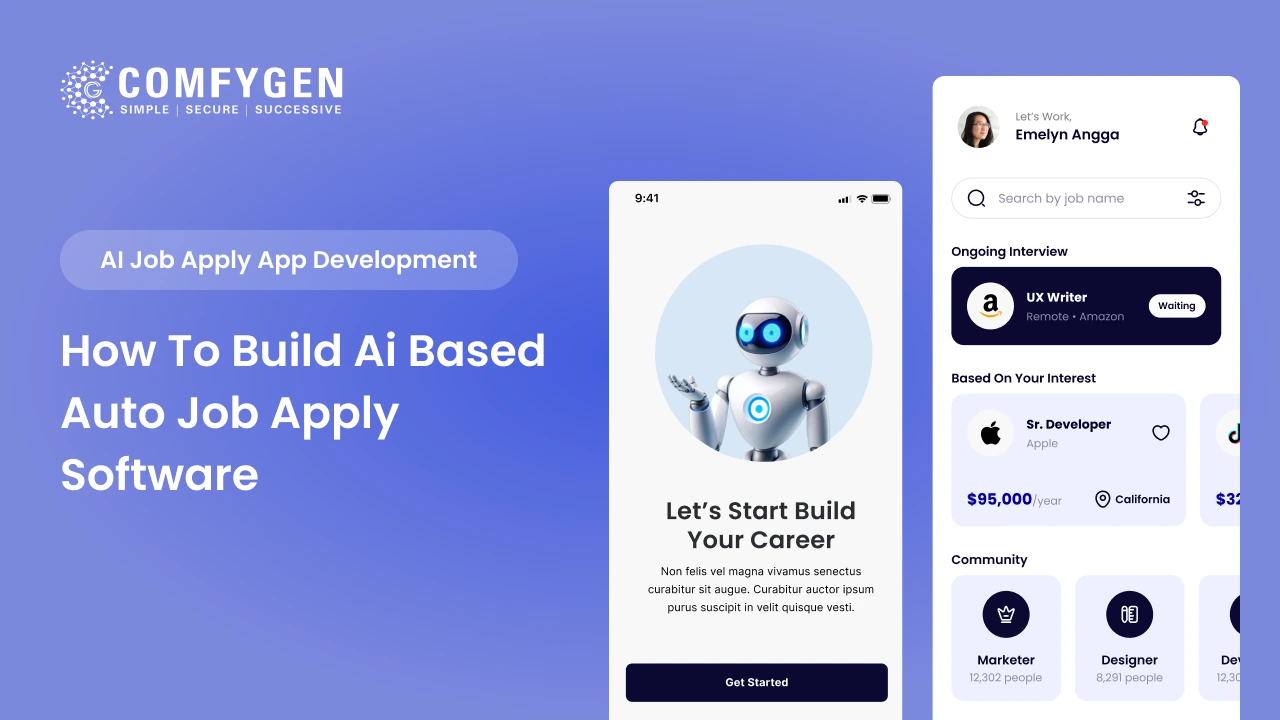
An AI-based job apply app costs $25,000 to $60,000 for an MVP and $90,000 to $200,000+ for a full platform with resume parsing, candidate ranking and recruiter dashboards. A working MVP takes 4 to 6 months. The build has two sides. The candidate side handles profile building, AI job matching and automated applications. The recruiter […]
AI mobile app development means building machine learning, natural language processing, computer vision or predictive models into an app so it adapts to each user instead of following fixed rules. Adding one AI feature to an existing app costs $15,000 to $45,000 and takes 6 to 10 weeks. A full AI-powered mobile app runs $40,000 […]

The food delivery industry runs on speed, personalization, and precision – and none of that is possible at scale without Artificial Intelligence. Platforms like Zomato, Swiggy, and Uber Eats don’t just deliver food; they use AI to predict what you want, when you want it, who should deliver it, and how to get it there […]